
Madison County Criminal Court Cases
Florida’s Third Judicial Circuit includes Madison County. Circuit Court handles felonies and circuit criminal proceedings. Madison County Court handles misdemeanors, county ordinance cases, and criminal traffic within its jurisdiction. The distinction matters when filtering a search or requesting an older file. A person who checks only one court level can miss a related prosecution in the other.
The Madison County Clerk of Circuit Court and Comptroller is custodian for both levels. Reviewed municipal sites did not provide a separate criminal merits portal. Questions about ordinance or citation processing should therefore go to the clerk. Court records document what prosecutors filed and what the court did. They differ from a sheriff’s arrest report or jail booking, which records law-enforcement and custody events.
Madison Criminal Courts Compared
Both trial courts use the same courthouse and clerk, yet their criminal coverage is different. This short comparison helps a Madison County case search start in the right division.
| Court | Typical criminal work | Record custodian |
|---|---|---|
| Circuit Court | Felonies and circuit criminal proceedings | Madison County Clerk |
| County Court | Misdemeanors, county ordinances, criminal traffic | Madison County Clerk |
Cases can also change character. Arrest charges are preliminary. The State Attorney may file different charges after screening the evidence. Compare the booking allegation with the information or indictment in the Madison County criminal case file.
Searching Madison County Case Records
Madison Online Court Records Search, or OCRS, is the county’s official online gateway. Choose Public for anonymous access. Attorney, Registered User, and Party Access require credentials and may show role-appropriate material that anonymous users cannot see. A case number is the strongest identifier. A name search needs care because suffixes, aliases, hyphens, and common names can create false matches.
- Open Madison OCRS and choose the Public access tile.
- Search by exact case number when known. Otherwise use the legal name and check variants.
- Narrow the result by court, filing year, and criminal case type when those controls appear.
- Open the case detail. Read every count, docket event, plea, adjudication, disposition, and sentence.
- Contact the clerk for a certified disposition, an archived file, or a document image that is unavailable online.
| Field Label | Type | Required | Notes |
|---|---|---|---|
| Access role | Tile | Yes | Public is anonymous; other modes require credentials |
| Party name | Text | No | Try legal name, suffix, alias, and spelling variants |
| Case number | Text | No | Most precise search key |
| Case type or year | Filter | No | Downstream controls can vary by role and vendor update |
The downstream interface can change. The research did not reliably expose every required marker or dropdown value, so no undocumented field should be assumed. Confirm identity through several case facts before relying on a same-name result.
Madison OCRS Access Choices
The official OCRS gateway visually separates anonymous public access from credentialed access.
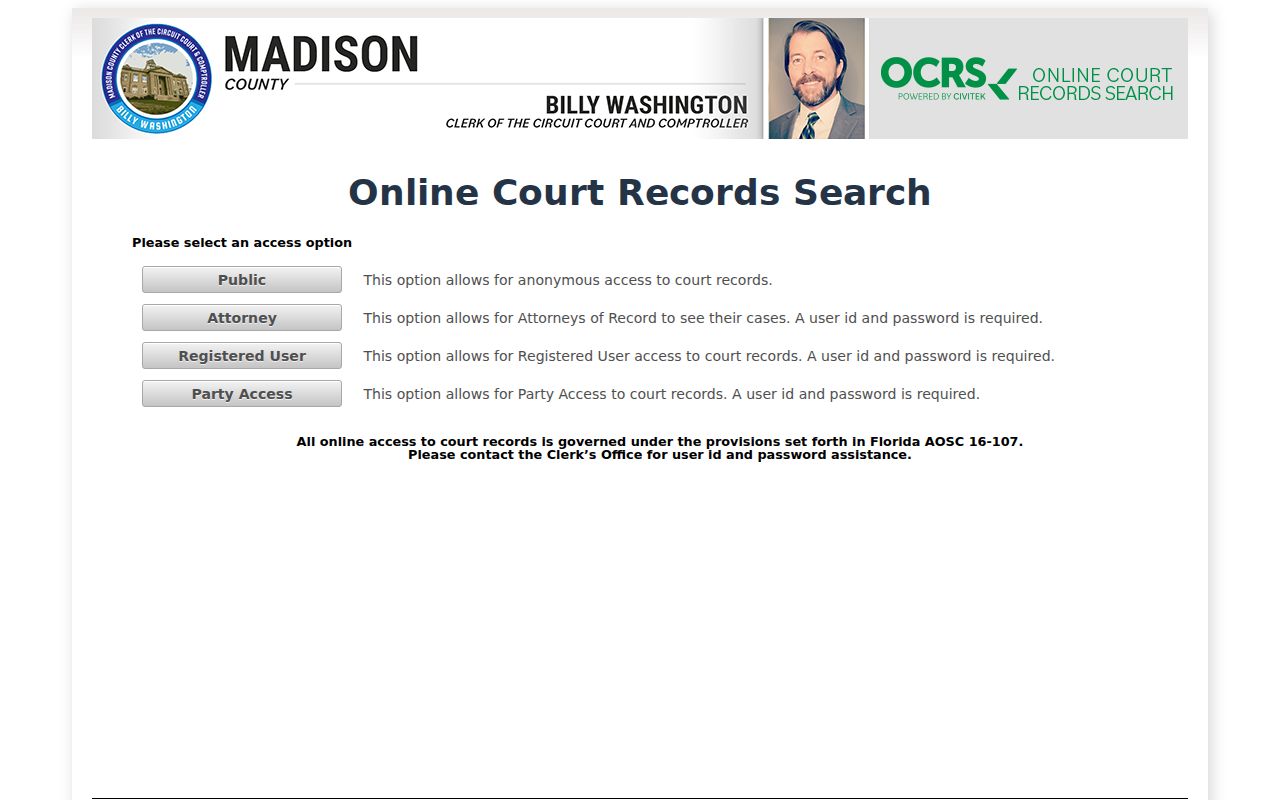
The gateway is only the starting point. Public users may see the docket while a document image remains limited by court-access rules or account role.
Inside a Madison County Case File
A Madison County criminal case file ties each count to a chronological docket. Read the charging document for the accusation the prosecutor actually filed, then locate the plea, adjudication, disposition, and sentence. Financial assessments and probation conditions may also appear. A status label is not a substitute for those entries.
| Case number and court | Identifies the file, division, and trial-court level. |
|---|---|
| Charging document | The information or indictment states filed counts, statutes, and degree. |
| Docket entries | A dated list of filings, orders, hearings, and other events. |
| Parties and counsel | Shows defendant, State, attorneys, and assigned judge where public. |
| Disposition and judgment | Records the outcome for each count and whether guilt was adjudicated. |
| Sentence and conditions | May include custody, probation, restitution, fines, costs, and balances. |
Reading Madison Case Outcomes
“Closed” describes file administration. It does not say how the case ended. Nolle prosequi means the prosecutor discontinued a filed charge. Dismissal ends a charge without conviction. An acquittal or not-guilty verdict is a merits outcome for the accused. A guilty adjudication is a conviction.
- Withhold adjudication
- The court accepts a plea or finding but does not formally adjudicate guilt. It is not a dismissal and can still carry a sentence and legal consequences.
- Disposition
- The final or operative outcome recorded for a charge.
- Docket
- The chronological event list, not the full text of every document.
- Capias
- Court process directing arrest, often after a charging event or failure to comply.
Read outcomes count by count. One Madison County case can contain a dismissed count and a different count that ends in conviction. A certified disposition from the clerk is the stronger record when formal proof of the court result is needed.
How a Criminal Case Moves
A criminal matter may begin with arrest or a notice to appear. First appearance addresses probable cause and release. Florida Rule of Criminal Procedure 3.130 generally calls for first appearance within 24 hours of arrest. Prosecutor screening follows, and the State Attorney decides whether and what to file. The accused is then arraigned on the filed charge.
Case flow: Charges Filed › Arraignment › Pretrial › Plea or Trial › Disposition › Sentencing
Discovery, motions, and pretrial conferences can reshape the case. It may end through dismissal, negotiated plea, or trial. Post-judgment motions and an appeal can add later docket entries. Timing varies, so the dated Madison criminal docket is more reliable than a generic timetable.
Madison Court File Counter
The online docket has a physical fallback. The Madison County Clerk is at 125 SW Range Avenue, Madison, Florida 32340. The mailing address is P.O. Box 237, Madison, FL 32341. Public hours are weekdays from 8:00 a.m. to 4:30 p.m., and the main number is 850-973-1500.
Clerk of Circuit Court
125 SW Range Avenue
Madison, FL 32340
850-973-1500
Weekdays, 8:00 a.m.-4:30 p.m.
Give the case number, party name, approximate year, and desired document title. State whether certification is needed and ask about delivery options. The inspected official pages did not publish a criminal-copy and certification fee table. Request a price estimate instead of assuming a charge. The clerk homepage confirms the local office and record route.
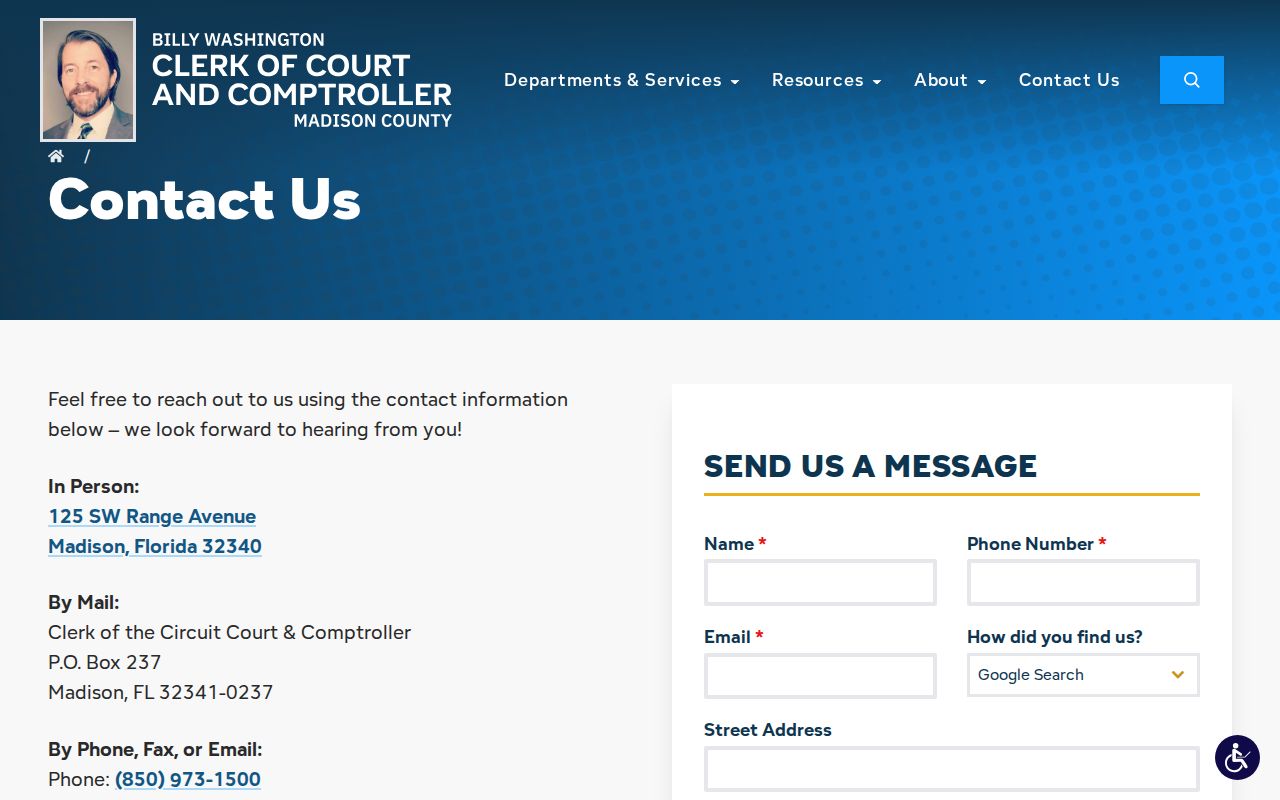
The contact page is the practical route for older files, certified outcomes, and image-access questions.
Madison Third Circuit Roles
The Third Judicial Circuit supplies the court structure for Madison and neighboring counties.
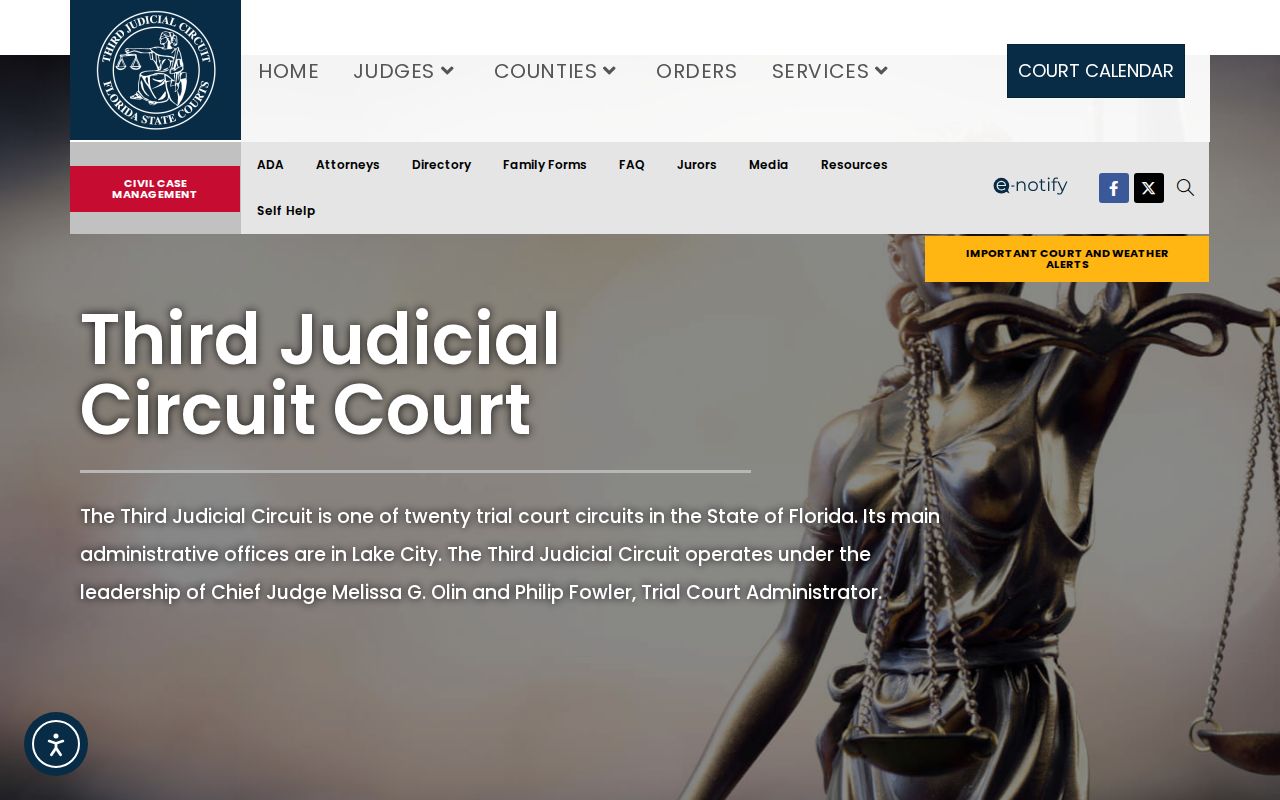
The Third Circuit State Attorney lists its Live Oak office as serving Madison County. The State Attorney screens arrests and files charges. The Third Circuit Public Defender is a separate office that represents eligible accused people. Neither office replaces the clerk as custodian of the court case file.
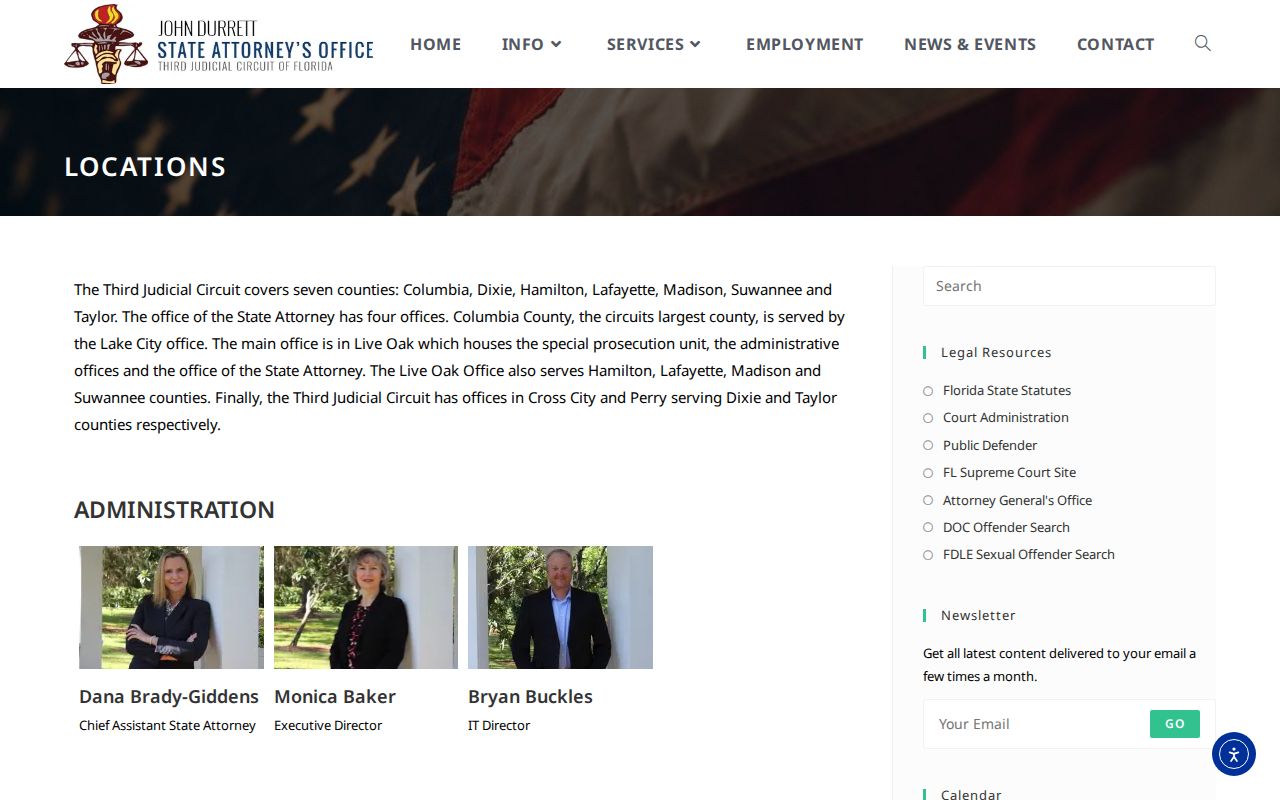
The prosecutor’s location explains why an arrest charge and filed information can differ. For the operative public record, return to the Madison docket and its count-by-count outcome.
Case Record Access and Restrictions
Florida judicial records follow Rule 2.420 access standards. That framework differs from treating every court question only as a Chapter 119 executive-agency request. Public dockets may redact a full birth date, Social Security number, account data, and victim or minor details. Juvenile, sealed, automatically sealed, and other confidential material may be absent or restricted.
An unavailable image does not prove that no document exists. Ask the clerk whether the file is archived, confidential, sealed, redacted, or limited to courthouse access. Qualifying non-conviction records may become confidential under Florida’s automatic sealing law. Court-ordered sealing and expunction use separate statutes and procedures. A public user should not try to bypass a lawful restriction through another access role.
The clerk records page routes readers to court records and clearing-record resources.
When a public result appears incomplete, compare the docket with the certified disposition and ask for the rule or statute supporting any denial.