
Checking Criminal History in Lee
First decide whether the sought file is a town administrative record, an incident report, a booking, or a court case. Sona Hayslett, Town Manager and Clerk, is Lee's public records custodian for town-created material. MCSO is the verified law-enforcement fallback. The Madison County Jail holds booking data, and OCRS holds filed prosecutions. FDLE provides the statewide history layer.
- Ask the town or MCSO which agency responded.
- Send town requests to the Lee custodian and police reports to the creating agency.
- Call the county jail for a Lee arrest booking.
- Search Madison OCRS for filed charges and outcomes.
- Use FDLE for statewide history or a review of your own record.
Lee Town Custodian Channels
Lee publishes a specific custodian: Sona Hayslett, Town Manager and Clerk, 286 NE CR 255, Lee, FL 32059. Requests may go by counter, phone at 850-971-5867, fax at 850-971-0092, or email at leemanager@leeflorida.org. No dedicated form or verified copy fee was found, so describe the record and ask about cost and delivery before ordering copies.
The Town contact page is the primary source for these channels.
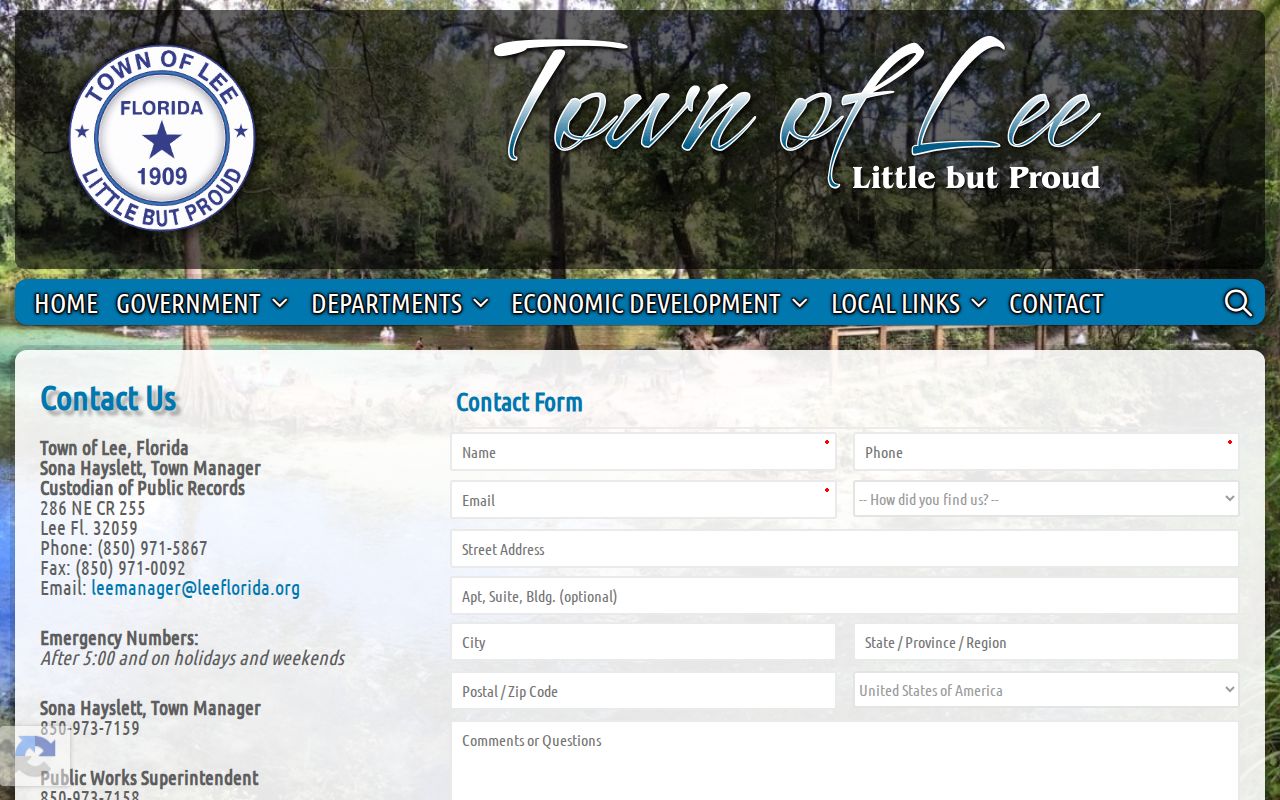
The assigned image documents the official route for town-created records, not sheriff incident reports.
Lee Police Department Records
The town publishes no police records unit, arrest database, public blotter, request form, or police app. That finding calls for verification, not an assumption about who polices every event. Contact MCSO dispatch or the town custodian, give the date and place, and ask which responder created the report.
If MCSO handled the call, request the report from Public Records/Warrants at 2364 W US 90, 850-973-4151, or sheriff@mcso-fl.org. A state-highway event may instead belong to Florida Highway Patrol. The report stays with its creator even if the person was later booked at the county jail.
Town Records Are Not Sheriff Files
Lee Town Hall keeps records made or received in town business. That may include council, code, utility, or administrative material. It does not automatically receive MCSO incident narratives, jail intake records, or criminal court dispositions. A request merely saying “all records about an arrest” is likely to cross several custodians.
Split the request by source. Ask Town Hall for the town file. Ask the arresting agency for its report. Ask the jail about booking. Ask the Clerk for the case. This source-based approach is the central Lee records distinction and prevents the town clerk from having to redirect a law-enforcement inquiry.
Lee Arrests and Bookings
When MCSO makes a Lee arrest, booking occurs at Madison County Jail at 823 SW Pinckney Street in Madison. Call 850-973-4002 because no public online county roster or Lee booking log was verified. Ask about current custody and booking identifiers. Do not expect Town Hall to hold the jail entry.
A booking records intake allegations and status at that moment. Prosecutors may decline, revise, or add charges. The court docket later shows what was filed and how it ended. The county arrest lookup has the fuller custody and request process.
From Lee Arrest to Docket
The local sequence is easy to follow once the record types are separated. The responder writes an incident report. The jail records intake. Prosecutors decide on formal charges. The Clerk creates a court case. A disposition can later be reported to FDLE.
Lee sequence: Responding agency › Madison County Jail › prosecutor › Madison County Court docket › FDLE.
A newly booked person may not yet appear in OCRS. Conversely, an older court case may remain searchable after county custody ends. Use name, date of birth, case number, and report number carefully because those identifiers belong to different systems.
Municipal Court Records in Lee
No separate Lee municipal criminal portal or local court search was found. Criminal prosecutions appear through Madison County Circuit or County Court. Contact the Clerk at 850-973-1500 with a case or citation number to confirm where a fine-only or ordinance-related matter is recorded.
| Verified court route | Madison County Circuit and County Courts |
|---|---|
| Case split | Felonies in Circuit; misdemeanors in County Court |
| Lookup | Madison OCRS or Clerk assistance |
| Contents | Filed charges, events, disposition, and sentence when public |
| Lee portal | No separate municipal criminal database verified |
Call Before Traveling from Lee
The Clerk, jail, and sheriff records office are in Madison rather than Lee. Calling first can confirm whether a file exists, which counter holds it, what identifiers are required, whether an image is public, and whether electronic delivery is available. It also avoids confusing the courthouse at 125 SW Range Avenue with the jail or sheriff headquarters.
Town Hall has its own local counter. The official Town of Lee website appears in the assigned image below.

Use it to verify current town contacts, while using county sources for law-enforcement and court files.
Where Lee Records Go
Lee administrative files stay with the town custodian. Law-enforcement reports stay with the responder. Booking data stays with Madison County Jail. Court files stay with the Clerk, and FDLE maintains the statewide criminal-history repository. No single Lee portal combines these sources.
Record flow: Responding law-enforcement agency › Madison County Courts › Florida Department of Law Enforcement
FDLE offers a paid public name search. A person reviewing their own history can use its free fingerprint Personal Review and correction process. FDC Offender Search is different again: it is for state correctional custody and supervision, not someone still held locally before trial.
Lee History and Custody Differ
An arrest report, court disposition, FDLE history, and FDC custody profile should not be read as interchangeable. The report explains the officer's account. The court establishes the filed charge and result. FDLE connects reported Florida arrest cycles and dispositions. FDC begins to matter after commitment to state correctional custody or supervision.
For an apparent error in a statewide history, use FDLE Personal Review rather than asking the town to change a state file. For an incorrect court outcome, obtain the certified disposition and contact the Clerk or FDLE through the documented correction path.
Keep an identifier sheet with the full name used at the time, birth date, incident place, responder, report number, booking number, citation, and case number. Each number points to another file and reduces same-name errors.
If OCRS returns no case after a recent arrest, ask the Clerk about filing timing. If the jail has no current result, the person may have been released or transferred. If FDC has no result, that says nothing about local pretrial custody. Each negative search is limited to its own system.
Ask whether electronic delivery is possible and whether redaction or staff time affects cost. Neither Lee's town copy fee nor an ordinance-hearing fee was verified, so confirm charges before payment. Use official phone numbers and domains, especially after the Clerk's 2025 warning about scams.
Lee Population Data Limits
Lee had 352 residents in the 2020 Census. In a town that small, a handful of incidents can cause a sharp swing in an annual rate. No independently attributable Lee Police crime series was found. MCSO county data can provide regional context, but it cannot be presented as though it describes Lee's town boundaries.
The official Census source supports the place population used here.
The image anchors the population figure while keeping criminal-record conclusions tied to the proper agency data.
Public Access Rules in Lee
Florida public-records law applies to nonexempt town and county records, but a request must reach the right custodian. Active investigative information, juvenile records, protected victim details, confidential identifiers, and sealed or expunged material may be withheld or redacted. Ask for the nonexempt portion when only part of a Lee-related file is restricted.
Describe the record with practical facts. A date range, Lee address, involved name, and known report, citation, or case number can help the custodian locate the correct file. Ask whether an electronic copy is available and whether the request will involve redaction or extensive staff time. The research did not verify Lee's copy charges, so obtain a cost estimate through the official custodian before paying.
A gap in public access has several possible causes. The event may be too new for the court system, the responder may be another agency, a document image may require greater access, or the record may be confidential. Sealing and expunction can also restrict qualifying records. For a court outcome, ask the Clerk. For a statewide personal-history issue, use FDLE Personal Review. Town Hall cannot modify a sheriff report, court disposition, or FDLE repository entry. Keep the agency's written response with the request details so a later follow-up reaches the same file.
Lee's town custodian and the county law-enforcement custodian answer different questions. A request to Sona Hayslett can reach town-created administrative material through the counter, phone, fax, or email channels. It does not automatically reach an MCSO incident report. A Lee requester should name the record type, event date, location, and likely creator. If the responder remains uncertain, call MCSO before sending a written request. This simple check is valuable because the town publishes no police portal, arrest log, criminal court search, or police app.
Travel planning also matters in Lee. Town Hall is at 286 NE CR 255, while the jail, Clerk, and sheriff records office are in Madison at three separate locations. Confirm that the desired record exists, whether it can be emailed, and any current charge before making the county-seat trip. A court case number or jail booking number can shorten that call.
Key Statutes:
Florida Statutes § 119.07 provides access to nonexempt public records.
Florida Statutes § 943.053 governs FDLE criminal-history dissemination.
Florida Statutes § 943.0595 addresses automatic sealing and linked court confidentiality.