
Checking Criminal History in Madison
Start a Madison criminal records check with the office that made the record. The City Clerk routes city-created material, including police incident reports when Madison Police handled the call. The county jail confirms booking and present custody. The Madison County Clerk keeps the criminal case after prosecutors file a charge. FDLE supplies the statewide history layer, but it does not replace a current report or certified court disposition.
- Confirm whether Madison Police, MCSO, or a state agency handled the event.
- Give the city custodian the date, address, report number, and desired format.
- Call Madison County Jail for booking or custody information.
- Search Madison OCRS and request a certified disposition from the Clerk when needed.
- Use FDLE for a Florida name search or a fingerprint-based review of your own record.
Madison's Four Record Counters
Madison is the county seat, so several record offices sit close together while retaining separate duties. City Hall routes city and police records. The courthouse keeps Circuit and County Court files. Madison County Jail keeps booking and custody data. Sheriff headquarters keeps MCSO reports and warrant records. Sending one broad request to the nearest counter can miss the file even when the event happened inside Madison.
Madison City Hall
321 SW Rutledge Street
Madison, FL 32340
850-973-5081
Weekdays, 8:00 a.m.-5:00 p.m.
County Court Clerk
125 SW Range Avenue
Madison, FL 32340
850-973-1500
Call first and explain whether the goal is an incident report, booking fact, docket, or certified outcome. That one distinction saves a misdirected Madison request.
Madison Police Department Records
The Madison Police page is part of city government. No police-specific database, request form, app, or blotter was verified. Lee Anne Hall, the City Clerk and Public Records Custodian, is therefore the sound starting point. A focused request gives the incident date, location, report number if known, people involved, and preferred copy format.
Do not assume a city address means Madison Police owns the report. MCSO communications dispatches both city and county responders, but the agency that created the report remains its custodian. A public police social page has shown 702 Duval Street; because the official city text did not publish a full records-unit block, call City Hall before traveling.
Madison City Custodian Channels
Madison accepts inquiries through the City Clerk at city.clerk@cityofmadisonfl.com, by phone at 850-973-5081, by fax at 850-973-5084, or at City Hall. No police-specific PDF form was found. A narrow written request helps a small office locate the file and state any lawful redaction or cost before work begins.
The city contact page is the current source for those details and the assigned image records that official route.
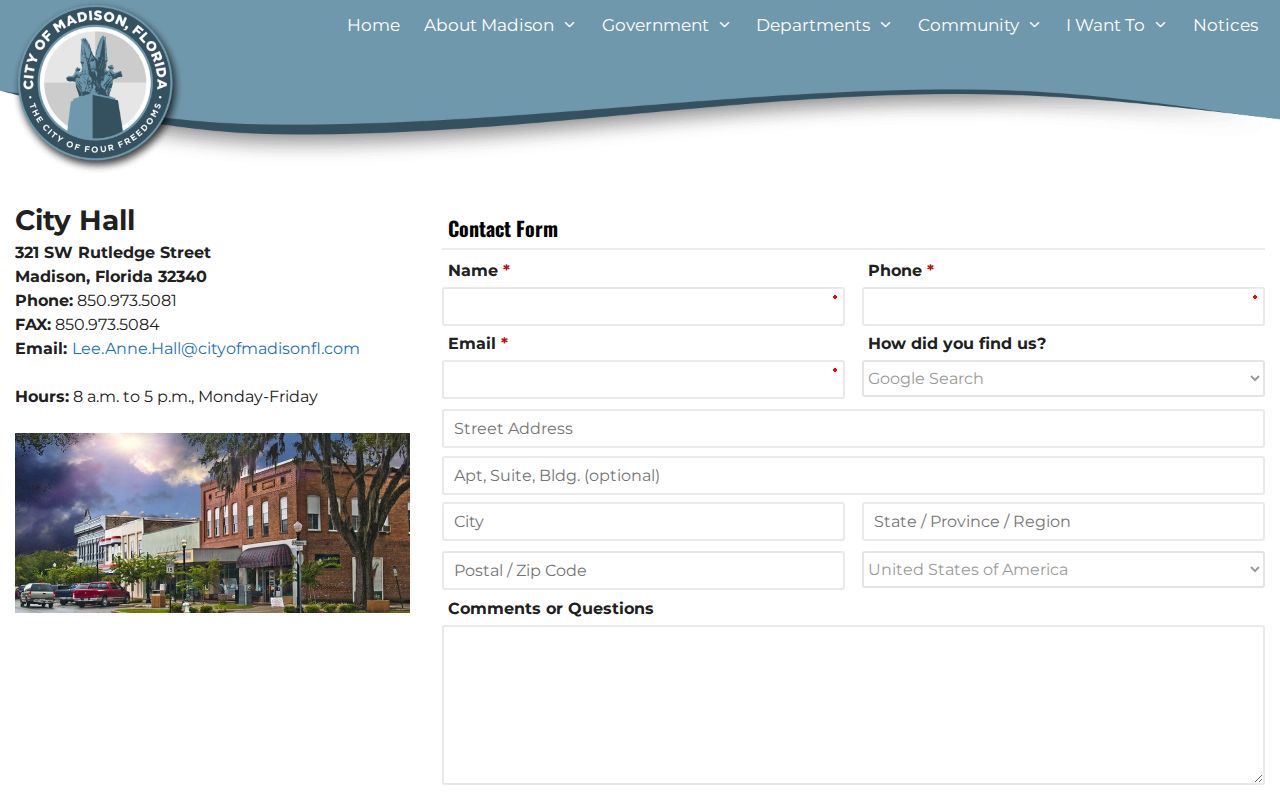
Check the live page before sending a request because staff listings and office details can change.
Madison Arrests and Bookings
People arrested by Madison Police are traced through Madison County Jail at 823 SW Pinckney Street. Call 850-973-4002 for current custody. No verified public web roster or city booking log was found, so a direct call is the official fallback. Intake records may show allegations, fingerprints, bond information, and custody status. They do not prove guilt or show the final filed charge.
Return to the arresting agency for the narrative and to the Clerk for the later case. This matters on highway events because Florida Highway Patrol may create the report even when the county jail receives the person. The county arrest lookup explains the full jail and request chain.
After a Madison Arrest
A city arrest creates files in stages. Police retain the incident report. The jail makes a booking record. Prosecutors choose whether and what to file. The Clerk opens the court case, and the disposition may later reach FDLE. The records may differ because each captures another point in the process.
Local sequence: Madison Police report › Madison County Jail booking › prosecutor decision › Circuit or County Court docket › FDLE update.
If a name appears in one channel but not another, check timing and identifiers. A fresh booking can precede a docket. The police number is not the court case number. A certified Clerk disposition remains the best local proof of how filed charges ended.
Municipal Court Records in Madison
No separate City of Madison criminal portal or municipal criminal database was located. Filed criminal matters run through Madison County courts. Felonies proceed in Circuit Court; misdemeanors and applicable lower-level cases proceed in County Court. For a citation or possible ordinance matter, call the Clerk with its number instead of assuming a separate city docket exists.
| Court route | Madison County Circuit Court or County Court |
|---|---|
| Case types | Felonies in Circuit; misdemeanors and lower-level matters in County |
| Lookup | Madison OCRS public access or Clerk counter |
| Docket | Filed charges, hearings, pleas, disposition, and sentence when public |
| Copies | Request from the Clerk and confirm current fees |
Madison OCRS Access Choices
The Clerk's CiviTek Online Court Records System offers Public, Attorney, Registered User, and Party Access choices. Most residents start with Public access. Results can show party names, case numbers, filing dates, court type, status, charges, and docket events. Document images may be limited by Florida access rules or account level.
A “closed” label does not reveal the result. Read the disposition. Dismissal, nolle prosequi, acquittal, conviction, and withhold of adjudication have distinct meanings. A withhold means the court did not formally adjudicate guilt after the plea or finding, though the public file may remain visible unless law restricts it.
Where Madison Records Go
Madison records do not merge into one city file. Police keep the report, the jail keeps intake information, the Clerk keeps the filed case, and the Florida Department of Law Enforcement maintains the statewide repository. Fingerprints and disposition reports help FDLE connect an arrest cycle to its outcome.
Record flow: Madison Police Department › Madison County Courts › Florida Department of Law Enforcement
Use the newest custodian for a recent event, then move outward as the matter matures. FDLE provides a paid public name search and a free fingerprint Personal Review for someone checking their own record. Neither replaces a certified local case disposition.
Madison Records Can Diverge
Four mistakes yield incomplete Madison results: treating a booking charge as final, requesting all reports from MCSO, searching FDC for someone still in county jail, and looking only in County Court for a felony. Match the question to the custodian. The agency explains the incident; jail documents intake; court controls the disposition; FDC covers state custody after commitment.
An arrest is not proof of guilt. Verify the filed charges and final result with the Clerk.
Identity checks matter at every stage. Use a full legal name, date of birth, and known case or report number when the office permits it. Similar names can produce the wrong docket or booking. When a Madison court result conflicts with a state history, obtain the certified disposition before starting FDLE's correction process.
Restricted access also explains gaps. Juvenile records, active investigations, sealed material, victim details, and protected identifiers may not appear publicly. A blank portal does not prove that no event occurred. The terms may be incomplete, the matter new, the image restricted, or the record confidential. Ask the custodian for a direct response.
County-Seat Records Concentration
Madison had 2,912 residents in the 2020 Census and is the county's largest incorporated place. Its county-seat role places City Hall, police routing, courthouse access, and jail functions in one community. Physical closeness helps, but each office still controls a different record.
The official city website appears in the assigned image below.
The official city channel should anchor city-record requests rather than an unverified third-party listing.
The assigned police source also documents the local department route.

Use it to confirm current police information before visiting a counter.
Public Access Rules in Madison
Florida public-records law generally covers records made or received in official city business. Access is not absolute. Active investigative details, juvenile material, sealed or expunged records, protected victim information, confidential identifiers, and restricted court images may be withheld or redacted. Ask for the releasable portion when only part of a Madison record is exempt.
A records custodian may ask for enough detail to locate a file, but a requester does not have to explain a personal motive merely to inspect an otherwise public record. Format and scope still matter. A short date range, one location, and a known report number can reduce search time. Before ordering paper, ask whether the city can provide the releasable portion electronically and whether a special service charge applies to an extensive request.
Sealing and expunction change access. Florida's processes do not mean every copy in every system vanishes at once, and eligibility depends on the case. Automatic sealing under section 943.0595 concerns qualifying nonconviction records. A Madison resident who sees an outcome that should be restricted should compare the Clerk's certified disposition with FDLE's Personal Review and follow the official correction path. The city custodian cannot decide eligibility or provide legal advice.
Madison requesters should keep the city report number separate from the court case number. City Hall can route a Madison Police report, while the Clerk uses its own case identifier after prosecutors file charges. If a records search begins with only a street and date, first ask which agency responded. That prevents a request from moving between Madison Police, MCSO, and Florida Highway Patrol. For an older case, a certified Clerk disposition is more useful than a stale booking copy because it shows the filed charge and final court action.
The county-seat setting makes same-day calls practical, but it does not merge custodians. Confirm availability with City Hall, the jail, and the courthouse separately before visiting. This is especially useful when a public OCRS result lists a docket event but withholds its image.
Key Statutes:
Florida Statutes § 119.07 gives access to inspect and copy nonexempt public records.
Florida Statutes § 943.053 governs FDLE criminal-history dissemination.
Florida Statutes § 943.0595 addresses automatic sealing and related court confidentiality.